Seguridad en la perforación DTH: Las normas que protegen a su equipo y sus herramientas.
Safety rules in drilling have a reputation for being obvious. Wear your PPE. Check the equipment. Don't stand under suspended loads. And because they're obvious, they get skimmed, skipped, or ignored — until the day someone takes a face full of rock chips because the air was still live when they bent down to check the bit.
DTH drilling has its own set of hazards that surface rotary drilling doesn't. High-pressure air. Heavy percussive shocks moving through the string. Bits and hammers that weigh enough to crush a hand if they slip during a change. Here are the rules that matter, explained not as compliance checkboxes but as the logic that keeps people walking away from the rig at the end of every shift.
Before the First Hole: The Pre-Shift Walk-Around
You can't fix a problem you didn't find, and you can't find it if you don't look. A thorough pre-shift inspection of a DTH rig takes ten minutes and covers three things:
The air system. Walk the full length of every air hose. Look for cuts, bulges, abrasion, and loose clamps at the couplings. A hose that blows apart under pressure doesn't just stop the drill — it whips. A high-pressure air hose that ruptures near a person can cause serious injury. Feel each coupling to confirm it's tight. Check the compressor gauges: air pressure should be stable at the rated working range with no pulsation that would indicate a failing regulator or leak.
The mast and feed system. Raise and lower the mast through its full range, listening for grinding or binding that would indicate worn bushings or bent guide rails. The mast needs to be straight and rigid — any flex or play in the mast translates directly to hole deviation.
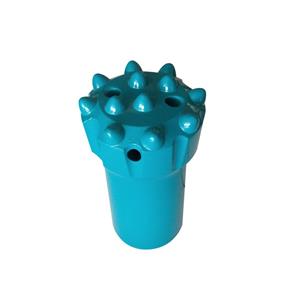
The tooling. Check the condition of the DTH hammer, the drill bit, and the drill rods that will go into the first string. A cracked bit body. A hammer with a scored piston bore. A rod with galled threads. Any of these can fail catastrophically mid-hole, and a downhole failure at depth with high-pressure air in the system is a safety incident waiting to happen.
When the Bit Is Being Changed: Zero Energy State
The most dangerous moment in DTH drilling isn't when the hammer is cycling at full power. It's when the crew is changing a drill bit at the collar and someone, somewhere, hasn't isolated the energy sources.
Before anyone puts their hands near the bit or hammer, three things must happen: the rotation drive must be locked out, the feed system must be locked out, and the air supply to the hammer must be completely isolated — not just throttled down, isolated. A hammer that receives even a low-pressure pulse of air while someone is working at the bit end can cycle unexpectedly, and a moving hammer piston in contact with a hand or tool is catastrophic.
The air isolation valve should be locked and tagged. The rotation and feed controls should be locked and tagged. Only the person doing the bit change should hold the keys to the locks. This isn't bureaucracy — it's the only reliable way to ensure that someone on the other side of the rig doesn't hit the wrong lever because they didn't know a bit change was in progress.
When the bit comes off, it should be handled with two hands or a lifting strap. A worn DTH bit can weigh 30 kilos or more. Drop it on a foot, and the shift is over. Place it on a stable surface away from walkways where nobody will trip over it.
Keeping the Hole Area Clear
When the hammer is cycling and air is blasting out of the hole, the immediate area around the collar is a hazard zone. Rock chips, dust, and occasionally small fragments of rock are ejected from the annulus at high velocity. Anyone standing at the collar without face protection is gambling with their eyesight.
The rule is simple: nobody at the collar while the hammer is cycling, unless they're the operator at the controls and wearing full face protection. Everyone else stays clear. If someone needs to approach the hole — to check cuttings, to measure depth, to add a rod — the hammer stops and the air is isolated first.
This rule also protects the equipment. A person at the collar can inadvertently drop a tool, a fitting, or a piece of debris into the hole. Anything that goes down the hole becomes an obstruction that the bit will hit on the next run, and hitting a steel object with a DTH bit is a fast way to destroy both the bit and the hammer.
Working on Slopes: The Stability Rule
DTH rigs are heavy, and a rig that's not stable on its footing is a rig that can slide, tip, or roll. On flat, level ground, the rig's own weight and track system keep it planted. On a slope, gravity changes the equation.
Before drilling on any incline, the tracks must be chocked with steel wedges or timber blocks — front and back, not just downhill. The wedges need to be sized for the slope angle and the ground condition. A wedge that's too small will kick out under load. A wedge placed on loose soil will dig in and the rig will shift.
Never drill across a slope — that is, with the mast oriented perpendicular to the fall line. A rig drilling across a slope has the highest center of gravity relative to its track width and is the most likely configuration to roll. Always orient the rig so the mast is aligned with the slope — either straight up or straight down the fall line. That puts the rig's long axis, and its greatest stability, in line with the direction it's most likely to move.
Air Hoses Under Pressure: The Invisible Hazard
Compressed air at 5 to 6 bar — the typical DTH operating range — doesn't look dangerous because air is invisible. But the stored energy in a pressurized hose is substantial. A coupling that separates under pressure becomes a projectile. A hose that ruptures releases enough energy to throw fragments of hose, rock, and coupling hardware in all directions.
Check every coupling before pressurizing the system. Don't use makeshift connections — jubilee clips on push-fit hose, threaded adapters that don't match, brass fittings where steel is specified. An air hose connection that fails under pressure near a person is one of the most preventable injuries on a drill site.
When maintaining or repairing any part of the air system, depressurize it first. Not dddhhhcrack the valve to let some pressure offdddhhh — fully depressurize. Bleed the entire line. Confirm zero pressure at the gauge before breaking any connection.